

A fashion design portfolio for students should do more than display a few attractive sketches. It should show how you think, how you develop an idea, how you solve design problems and how far you can take a concept from research to a finished garment.
This becomes even more important after graduation.
If you are completing postgraduate fashion training and preparing for internships, freelance work, jobs or your own label, your portfolio may become one of the clearest ways to present your abilities.
A recruiter, designer or potential client cannot understand your skills from your course certificate alone. Your portfolio gives them a closer look at your illustration, garment development, pattern work, styling, digital skills, research and finished projects.
The challenge is deciding what deserves a place in it.
This guide explains what postgraduate fashion students should include, what to leave out and how to present their work clearly.
What Is a Fashion Design Portfolio?
A fashion design portfolio is a selected collection of your design work.
It can show both the final result and the process behind it.
Depending on your specialisation, a portfolio might contain:
- research
- mood boards
- concept development
- colour stories
- fashion illustrations
- fabric exploration
- textile work
- pattern development
- garment construction
- draping
- CAD work
- styling
- photography
- finished collections
- internship or live-project work
A good portfolio should not feel like a folder containing every assignment completed during your course.
Selection matters.
Your strongest work should help someone understand what kind of designer you are becoming.
Why Is a Portfolio Important After Graduation?
After graduation, you may be entering situations where people know very little about you.
An employer may see your application for the first time.
A client may be deciding whether your design style suits their requirements.
A fashion studio may be comparing several internship applicants.
Your portfolio gives these people evidence of your work.
For postgraduate students, it can be particularly useful because students may have entered fashion after studying a completely different subject at undergraduate level.
Your earlier degree may not show your current fashion skills.
A strong fashion portfolio after graduation can.
It shows what you learned after entering fashion and how you have applied those skills through actual projects.
A Portfolio Should Show Process, Not Just Final Designs
One common mistake students make is showing only finished illustrations.
Imagine seeing a final image of a dress.
It might look good, but several questions remain:
Where did the idea come from?
What research influenced it?
How did the silhouette develop?
Why was that fabric selected?
Was a pattern created?
Did the design change after fitting?
Was the garment actually constructed?
A stronger portfolio can show parts of this journey.
For example:
For example:
Research → Concept → Mood Board → Illustration → Fabric Selection → Pattern/Draping → Development → Finished Garment → Final Shoot
You do not need to show every small step for every project.
But showing enough development helps the viewer understand that the final design was the result of an actual design process rather than simply a drawing.
1. Start With a Clear Introduction
The first part of your professional fashion design portfolio should create context.
Keep it simple.
You can include:
- your name
- your fashion specialisation
- a short introduction
- your key areas of interest
- relevant software or technical skills
- contact information when appropriate
Avoid writing a long autobiography.
Someone viewing your portfolio should quickly understand whether your interests lie in areas such as womenswear, menswear, styling, textiles, accessories, garment construction or another fashion direction.
Your portfolio itself should provide the evidence.
2. Include Research and Inspiration
Fashion projects rarely begin directly with a finished garment.
Research helps students develop ideas.
Your portfolio can show selected references that influenced the project, such as:
- art
- architecture
- nature
- culture
- historical clothing
- textiles
- photography
- objects
- social themes
- personal observations
However, research pages should not simply become large collections of random internet images.
Show a connection.
If traditional architecture inspired your collection, explain how its lines, shapes, colours or details influenced your garments.
The purpose of research is not to prove that you found many references.
It is to show how you converted inspiration into design decisions.
3. Add a Focused Mood Board
Mood boards are common in fashion portfolio for students projects, but they are often poorly used.
A mood board should communicate the atmosphere and visual direction of the project.
It may include:
- colours
- textures
- shapes
- photographs
- material references
- cultural influences
- visual details
The board should feel connected.
If every image looks unrelated, the viewer may struggle to understand the concept.
A useful mood board gives your project a visual language that can later be seen in your illustrations, fabric selection and final garments.
4. Show Your Colour Story
Colour can communicate mood before someone even studies the garment details.
Include a focused colour palette when it plays an important role in your project.
Instead of adding ten or fifteen unrelated colours, show the colours you actually intend to use.
You can also explain briefly why those colours fit the concept.
For example, a collection inspired by monsoon landscapes may use very different colours from a collection influenced by Indian festive architecture.
The important thing is consistency between your research, colour decisions and final designs.
5. Include Fashion Illustrations
Fashion illustration is one of the most expected sections in a fashion design portfolio for students.
Your illustrations can demonstrate:
- silhouette development
- proportions
- styling
- colour choices
- fabric representation
- garment details
- design variety
Do not fill the portfolio with dozens of nearly identical illustrations.
Select work that shows your strongest ideas and a useful range of abilities.
You can include both hand-drawn and digital work if both are relevant to your skills.
What matters is that the illustrations communicate the garments clearly.
A beautiful illustration that hides the actual design is less useful than one that lets the viewer understand what you intend to make.
6. Show Design Development
This section can separate a thoughtful portfolio from one that simply looks attractive.
Design development shows how an initial idea changed before becoming a final design.
You might show:
- rough thumbnails
- silhouette experiments
- sleeve variations
- neckline options
- length changes
- detail development
- print experiments
- fabric alternatives
Not every early sketch needs to be beautiful.
That is fine.
Development work exists to show thinking.
For example, you may begin with six sleeve concepts, select two, test one through draping and eventually use a modified version in the final garment.
Showing some of that journey makes the portfolio more informative.
7. Include Textile and Fabric Exploration
A fashion designer needs to understand materials, not simply garment shapes.
Your portfolio can include relevant fabric work such as:
- swatches
- textile experiments
- surface ornamentation
- embroidery samples
- fabric manipulation
- print development
- texture experiments
Explain why particular fabrics were selected when necessary.
The viewer should be able to understand how material choice supports the design.
For example, if your silhouette depends on strong volume, a very soft fabric may produce a different result from a structured material.
Showing this understanding adds depth to the project.
8. Show Pattern Making Where Relevant
Students often ask how to make a fashion design portfolio that demonstrates technical ability.
Pattern-making work is one good way.
You do not need to fill several pages with complete full-size patterns.
Instead, show selected evidence of how you translated a design into a workable garment.
This can include:
- pattern-development photographs
- flat-pattern experiments
- pattern manipulation
- toile development
- fit corrections
- construction stages
For an advanced student, this helps show that you understand more than illustration.
You understand how a garment begins taking physical form.
9. Include Garment Construction
If you have constructed garments during your course, make them visible.
Use clear photographs.
You can show:
- construction details
- seams
- closures
- collars
- sleeves
- finishing
- surface details
- internal construction where relevant
Close-up photographs can be useful when a garment includes a technique that cannot be understood from the full-body image.
For example, if your strongest feature is hand embroidery or an unusual sleeve construction, include a detail shot.
But do not overload every page with tiny photographs.
Give the strongest work enough space.
10. Add Draping Experiments
Draping can produce excellent portfolio material because it shows direct experimentation with fabric and form.
You could include photographs showing:
Initial Draping → Shape Development → Adjustment → Final Silhouette
This gives the viewer an idea of how you work three-dimensionally.
Draping experiments do not always need to result in a completely finished garment to have portfolio value.
Sometimes an interesting experiment can show creativity and technical exploration on its own.
11. Include CAD and Digital Fashion Work
Digital design skills are increasingly useful when developing a fashion design portfolio presentation.
If you have learned CAD or related digital tools, include relevant examples.
Depending on your training, these could include:
- digital fashion illustrations
- technical drawings
- garment variations
- colour variations
- presentation sheets
- digital layouts
- fashion graphics
Avoid adding digital work simply to prove that you know a software program.
Choose examples where the digital tool helped you communicate or develop the design effectively.
ISFT’s Post Graduate Diploma in Fashion Design & Technology includes CAD as part of its second-semester curriculum, alongside Portfolio, Styling & Photography, Draping and Pattern Making & Garment Construction.
12. Add Styling and Fashion Photography
Once a garment is complete, presentation becomes important.
A final fashion shoot can show how you imagine the garment being worn and communicated.
Think about:
- model selection
- styling
- accessories
- footwear
- hair
- makeup
- location
- lighting
- poses
- composition
These choices should support the concept rather than distract from the garment.
Students interested in styling can go further and create dedicated styling projects.
For example, you could develop:
- editorial styling
- occasion styling
- personal styling concepts
- theme-based fashion shoots
This broadens the portfolio beyond garment design.
ISFT’s postgraduate fashion curriculum includes Fashion Styling & Photography, making this a natural area for students to connect with their portfolio development.
13. Show Complete Projects, Not Random Pages
One of the strongest fashion design portfolio ideas is also one of the simplest:
Create clear projects.
Instead of:
Page 1 – random illustration
Page 2 – embroidery
Page 3 – unrelated photograph
Page 4 – CAD drawing
Page 5 – another sketch
try building a complete story.
Project 1
Research
→ Mood board
→ Design development
→ Fabric
→ Illustration
→ Pattern/draping
→ Final garment
→ Photography
Project 2
New concept
→ New process
→ New outcome
This makes the portfolio easier to understand.
It also allows each project to demonstrate multiple skills.
14. Include a Collection Project
A collection project can be particularly useful for postgraduate students.
Rather than presenting only individual garments, create a small group of designs that belong together.
A collection should have some consistency in:
- concept
- silhouette
- colour
- materials
- detailing
- target customer
At the same time, every outfit should not look identical.
A good collection demonstrates your ability to maintain a clear direction while creating variation.
You could show initial collection sketches and then highlight the designs that were developed further.
15. Include Relevant Internship or Live Project Work
Internship experience can strengthen a fashion portfolio after graduation, especially when you are allowed to show the work.
This could include:
- research
- design assistance
- styling
- garment development
- merchandising-related work
- photoshoot assistance
- craft documentation
- production learning
Be careful with confidential work.
Do not publish designs, client information or company material unless you have permission to show it.
If you cannot display the actual work, you may still be able to explain the type of tasks or skills developed without revealing protected information.
ISFT includes Craft Study & Internship within its PG Fashion Design & Technology curriculum.
16. Show Your Strongest Fashion Portfolio Projects
Students sometimes assume more pages mean a stronger portfolio.
Not necessarily.
One weak project can reduce the overall quality of the presentation.
Choose your strongest work.
A useful portfolio might include projects that demonstrate different skills.
Fashion Portfolio Project Ideas
Concept Collection
Develop a collection around a focused theme.
Textile Exploration
Create a project where fabric manipulation, surface ornamentation or material development is central.
Garment Construction Project
Take one design from illustration through pattern development and final construction.
Draping Project
Develop silhouettes directly on a dress form.
CAD Project
Present digitally developed fashion concepts and technical work.
Styling Project
Create a complete styling story and photoshoot.
Craft-Based Project
Research a craft and develop an original fashion response inspired by your findings.
Merchandising Project
Explore how a collection could connect with a customer, market or retail environment.
You do not need all of these.
Choose fashion portfolio project ideas that match the career direction you want to pursue.
17. Tailor Your Portfolio to the Opportunity
There does not need to be one permanent version of your portfolio for every situation.
Suppose you are applying for a garment-design position.
Your portfolio should make illustration, pattern development, construction and finished garments easy to find.
If you are applying for styling work, styling projects and photography deserve greater visibility.
If you want to work in digital fashion, CAD and digital presentation may become more important.
This does not mean creating the entire portfolio again every time.
It means understanding which work is most relevant to the viewer.
A professional fashion design portfolio should feel selective rather than generic.
18. Keep the Layout Clean
Strong fashion work can become difficult to appreciate when the page design is overcrowded.
You do not need to decorate every empty area.
White space is useful.
Keep:
- margins consistent
- typography readable
- headings clear
- image quality high
- page structure consistent
Avoid using too many fonts, decorative elements or unrelated graphics.
The layout should support your fashion work rather than compete with it.
19. Pay Attention to Image Quality
Poor photographs can make good garments look weaker.
When photographing student work:
- use sufficient light
- avoid distracting backgrounds
- keep garments clearly visible
- photograph important details
- maintain suitable image resolution
- check colour accuracy where possible
You do not need an expensive editorial shoot for every assignment.
But photographs should be clear enough for someone to understand the work.
For final portfolio pieces, investing more effort in photography can make a noticeable difference.
20. Edit Your Portfolio Carefully
Your first portfolio draft should not automatically become the final version.
Review every page.
Ask:
Does this project deserve to be included?
Is this image helping?
Can the viewer understand the project without a long explanation?
Are there several pages showing almost the same skill?
Does my strongest project appear early enough?
Are spelling and grammar correct?
Does the portfolio feel like one person created it?
Editing often improves a portfolio more than adding another project.
Common Fashion Portfolio Mistakes to Avoid
Including Every College Assignment
Your portfolio is a selection, not an archive.
Showing Only Final Illustrations
Include enough development to demonstrate your thinking and practical understanding.
Using Low-Quality Images
Blurry photographs can weaken otherwise strong projects.
Adding Too Much Text
Use short explanations where they add context. Let the work remain the main focus.
Copying Another Student’s Style
Looking at fashion student portfolio examples can help you understand presentation methods, but your portfolio should still represent your own work and visual thinking.
Creating an Overdesigned Layout
The portfolio itself does not need to compete with your garments.
Showing Only One Skill
Unless you are applying for a highly specialised role, postgraduate students can benefit from showing a mix of creative and technical abilities.
Hiding the Development Process
Your process often reveals skills that the final photograph cannot show.
A Simple Fashion Portfolio Structure
Students who do not know where to start can use this basic structure:
- Cover Page
Name and specialisation.
- Short Introduction
Your interests and key skills.
- Project One
Research → Development → Final Outcome
- Project Two
A different concept or skill.
- Technical Project
Pattern making, construction or draping.
- Digital Work
CAD or digital fashion development.
- Styling / Photography
Selected visual work.
- Additional Strong Project
Choose something that adds a new skill or perspective.
- Internship / Industry Work
Include only what you are allowed to present.
- Contact / Closing Page
Keep it simple.
This is only a starting structure. Your portfolio should ultimately reflect the work you actually have.
How Often Should You Update Your Fashion Portfolio?
A portfolio should change as your work improves.
If you finish a stronger project, consider whether it should replace an older piece.
After an internship, you may have new experience worth including.
If your career interests change, reorder the work accordingly.
Students should not treat portfolio development as something that happens only in the last week of a course.
Save your process regularly.
Photograph samples.
Keep early sketches.
Organise CAD files.
Document garment fittings.
Photograph finished work properly.
When portfolio time arrives, you will have better material to choose from.
Building a Portfolio During Postgraduate Fashion Study
Portfolio development works best when it is connected to what students are already learning.
ISFT’s Post Graduate Diploma in Fashion Design & Technology includes areas such as Fashion Illustration, Pattern Making & Garment Construction, Fashion Styling & Photography, Draping, CAD, Portfolio, and Craft Study & Internship.
This combination gives students several types of work that may contribute to a portfolio rather than limiting the presentation to illustration alone.
Graduates who want structured fashion training can explore ISFT’s Post Graduate Diploma in Fashion Design & Technology. The programme is open to graduates from any discipline and includes both practical and digital areas of fashion study.
Final Thoughts
A strong fashion design portfolio for students is not created by adding as much work as possible.
It is created through selection.
Show where the idea started.
Show how it developed.
Show enough technical work to prove you understand how fashion is made.
Show the final result clearly.
And make every project earn its place.
For postgraduate fashion students, a portfolio can bring together illustration, textiles, pattern making, garment construction, draping, CAD, styling, photography and internship learning in one clear presentation.
Your certificate tells people which course you completed.
Your portfolio shows what you learned to do.
FAQs
What should a fashion design portfolio for students include?
A student portfolio can include research, mood boards, illustrations, textile exploration, design development, pattern work, garment construction, CAD, styling, photography and selected finished projects.
How do I make a fashion design portfolio after graduation?
Start by collecting your strongest projects. Organise each important project around its concept, development process, technical work and final result. Remove repetitive or weak work and maintain a clean presentation throughout.
Should I include sketches in my fashion portfolio?
Yes. Selected sketches and development drawings can show how your ideas evolved before reaching the final design.
Should fashion students include garment construction work?
If garment design is relevant to your career direction, showing pattern development, samples, construction details and finished garments can demonstrate practical knowledge.
Is CAD useful in a fashion design portfolio?
Yes. Relevant CAD work can demonstrate digital design and presentation skills. ISFT currently includes CAD as part of its postgraduate fashion curriculum.
Should I include every project from fashion college?
No. Select your strongest and most relevant projects. A shorter portfolio containing strong work is usually easier to evaluate than one filled with repetitive assignments.
Can I include internship work in my portfolio?
Yes, when you have permission to show it. Do not include confidential client, company or unreleased design information without approval.
What are some good fashion design portfolio ideas?
Collection development, garment construction, draping, textile experimentation, fashion styling, CAD design, craft research and accessory development can all work well when they show genuine skills and a clear process.
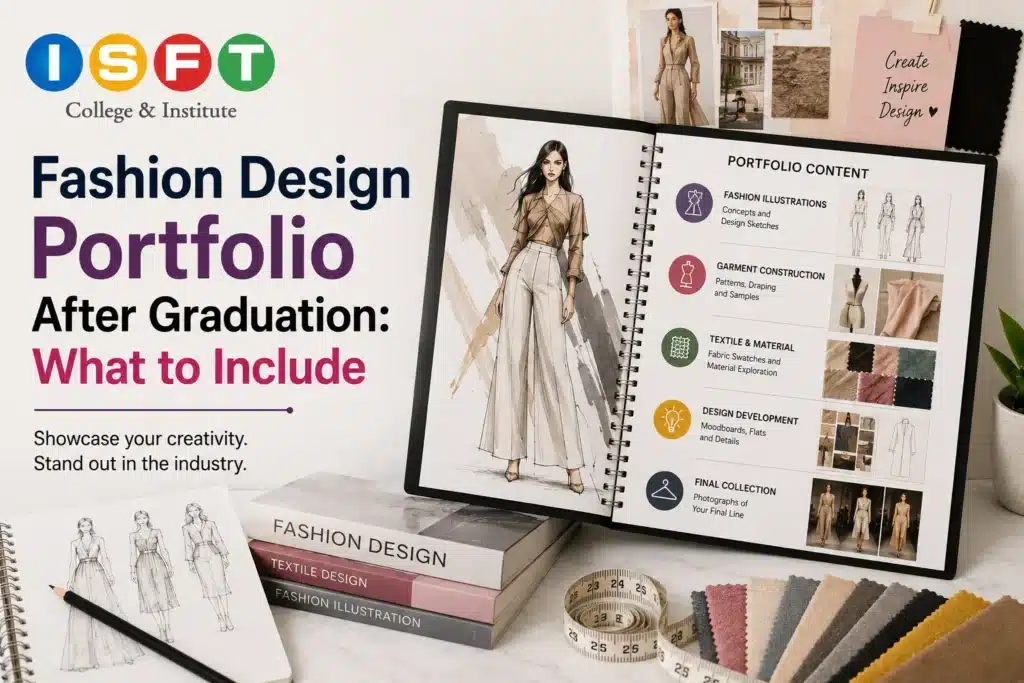
Table Of Content
- What Is a Fashion Design Portfolio?
- Why Is a Portfolio Important After Graduation?
- A Portfolio Should Show Process, Not Just Final Designs
- Common Fashion Portfolio Mistakes to Avoid
- A Simple Fashion Portfolio Structure
- How Often Should You Update Your Fashion Portfolio?
- Building a Portfolio During Postgraduate Fashion Study
- Final Thoughts
- FAQs
