

Student fashion event production brings garment design, styling, model coordination, runway planning and photography into one shared project. It gives fashion students an opportunity to see how individual garments behave when they leave the classroom and become part of a complete visual presentation.
A fashion event may last only a few minutes for the audience, but preparing it involves many connected decisions. Students need to develop a clear theme, edit their collections, complete fittings, plan the sequence, arrange accessories, brief models and coordinate backstage changes. The photography team must also understand which details matter and when they will appear.
If one part is ignored, the entire presentation can feel unclear. A well-made garment may be hidden by unsuitable styling. A strong collection may lose its rhythm because of a poor running order. A confident runway moment may never reach the portfolio if it is not photographed properly.
This guide explains how those separate parts come together—and why students learn so much during the process.
What Is a Student Fashion Event?
A student fashion event is an organised presentation of garments, styling work or design collections developed by learners. It may take the form of:
- A runway presentation
- A themed fashion show
- A collection display
- A styling showcase
- A fashion exhibition
- A photographed editorial presentation
- A college fashion event
- A portfolio or final-project presentation
The format can vary according to the purpose, available space, number of collections and academic requirements.
The event is not simply a place to show finished clothes. It is also a practical exercise in planning, editing, communication and teamwork.
Students experience how a fashion idea changes as it moves through several stages:
- Research and concept
- Collection development
- Garment construction
- Fitting
- Styling
- Model coordination
- Runway sequence
- Backstage preparation
- Photography
- Final review and documentation
Each stage influences the next. The event therefore becomes one connected design project rather than a collection of unrelated outfits.
Why Fashion Events Matter for Students
Classroom assignments teach important individual skills. Fashion events test whether students can combine those skills under practical conditions.
They turn ideas into complete presentations
A sketch communicates a garment idea, but an event shows how that garment looks in motion, under lighting and beside the rest of the collection.
They teach deadlines
Designers often want one more correction, one more fitting and one more accessory option. An event date eventually replies, “No.” Students learn to prioritise the changes that matter most.
They build teamwork
A fashion presentation may involve designers, stylists, models, makeup teams, coordinators, photographers and technical support. Clear communication is necessary because no single person controls every stage.
They improve decision-making
Students must edit their ideas. Not every garment, accessory or styling concept can appear in the final sequence.
They develop presentation awareness
The audience sees the complete visual result. Students learn to consider music, pace, order, grooming, lighting and photography alongside garment design.
They provide portfolio material
A well-documented event can produce runway photographs, backstage images, collection shots and process material for student portfolios.
Fashion Event Planning for Students
Fashion event planning for students begins by defining the purpose. Without a clear objective, teams may spend time choosing decorations before they have decided what the event needs to communicate.
Useful planning questions include:
- What is the purpose of the event?
- Who is the intended audience?
- How many student collections will be shown?
- How many looks are included in each collection?
- What is the available venue and runway format?
- How much preparation time is available?
- Which teams and roles are required?
- How will models change between looks?
- What needs to be photographed?
- How will the event be documented afterwards?
The plan should then be divided into stages, responsibilities and deadlines.
Student Fashion Event Production Workflow
How Does Student Fashion Event Production Work?
Student fashion event production works through a planned sequence that connects concept development, collection editing, garment preparation, styling, rehearsals, backstage management and photography. Each stage should have a responsible person and a clear deadline.
Stage 1: Define the event concept
The concept sets the overall direction. It may be based on a theme, academic project, design collection or broader visual idea.
The event team should define:
- Main message
- Mood
- Visual language
- Colour direction
- Collection categories
- Runway format
- Audience experience
A theme should guide decisions without forcing every collection to look identical. Students still need space to communicate their own work.
Stage 2: Review the collections
Each collection should be examined as a complete group. Students and mentors may review:
- Design connection
- Colour consistency
- Fabric relationships
- Silhouette variation
- Garment completion
- Fit
- Construction
- Styling possibilities
- Strongest opening and closing looks
The purpose is not to include every garment simply because it took time to make. The final selection should communicate the collection clearly.
Stage 3: Create the event schedule
The team should prepare a working timeline for fittings, styling, rehearsals, photography and the main presentation.
Allow time for corrections. If the entire schedule depends on every garment being perfect at the first fitting, the schedule is optimistic enough to deserve its own fashion award.
Stage 4: Assign responsibilities
Roles may include:
- Event coordinator
- Collection coordinator
- Backstage manager
- Styling team
- Model coordinator
- Garment assistant
- Hair and makeup coordinator
- Runway or stage coordinator
- Music coordinator
- Photography coordinator
- Documentation team
One person may handle more than one responsibility during a smaller event, but the ownership of each task should remain clear.
Stage 5: Prepare running documents
Useful working documents may include:
- Master schedule
- Model list
- Designer list
- Look numbers
- Running order
- Fitting notes
- Accessory checklist
- Garment-change chart
- Photography brief
- Emergency contact list
The documents should be available to the relevant people and updated when changes occur.
Building a Collection for the Event
A garment collection needs a clear relationship between its looks. The connection may come from inspiration, colour, fabric, silhouette, technique or styling.
Students should review the collection from a distance rather than evaluating only one garment at a time.
Collection story
The audience should be able to sense a direction even without reading a long explanation. The collection may move from simple to dramatic, light to dark or structured to fluid.
Number of looks
The suitable number depends on the event and academic brief. Every selected look should contribute something useful.
Silhouette variety
The collection needs enough variation to remain visually interesting, but excessive difference may weaken unity.
Colour progression
Colours can be organised to create rhythm. Similar shades may be grouped, or contrast may be introduced deliberately.
Fabric relationship
Different fabrics can work together when they share a clear idea. Their weight and movement also affect the runway sequence.
Hero look
A hero look is the strongest or most representative outfit in the collection. It may open the sequence, close it or appear at another planned moment.
The most heavily decorated garment is not automatically the hero. Sometimes the clearest design makes the strongest final impression.
Garment Preparation Before Styling
Styling cannot begin properly if the garments are unfinished, incorrectly labelled or awaiting major construction changes.
Before the styling review, students should check:
- Seams and closures
- Fastenings
- Hemlines
- Surface details
- Loose threads
- Pressing
- Garment labels
- Matching pieces
- Accessories
- Fit notes
- Repair requirements
Each look should be stored separately and clearly numbered. Accessories should remain with the correct outfit.
Garment bags, hangers or organised containers can help, depending on the event setup. A visual look card attached to each outfit reduces backstage confusion.
A black belt, silver belt and “the belt we used yesterday” are not three clear labels. Backstage teams need precise identification.
The Collection Styling Process
The collection styling process defines how garments, accessories, footwear, hair, makeup and model presentation work together.
Styling should support the designer’s idea. It should not introduce so many extra elements that the original garment becomes difficult to notice.
Understand the collection first
The stylist needs to know:
- Inspiration
- Intended mood
- Target wearer
- Key colours
- Important garment details
- Preferred silhouette
- Areas that must remain visible
Select accessories carefully
Accessories can complete a look, create contrast or connect separate outfits. They can also become distracting.
Students should ask whether an accessory:
- Supports the collection
- Fits the garment proportion
- Allows safe movement
- Interferes with construction details
- Repeats unnecessarily
- Looks consistent across the sequence
Plan footwear
Footwear influences posture, walking pace and garment length. It should be selected before final fittings and rehearsals.
Develop hair and makeup direction
Hair and makeup should relate to the collection theme and event format. The direction may be consistent across all models or varied between collections.
Reference images and clear face charts can reduce confusion.
Test the complete look
A garment may appear balanced on a hanger but change after accessories, footwear, hair and makeup are added.
Photograph the complete test look from the front, side and back. This makes unnecessary elements easier to identify.
Model Selection and Look Allocation
Models should be allocated according to the garments, presentation plan and event requirements. The process should focus on fit, movement and the ability to present the outfit clearly.
Important considerations include:
- Garment measurements
- Model measurements
- Walking comfort
- Footwear
- Number of changes
- Time between looks
- Collection sequence
- Garment complexity
- Model confidence
- Event format
Students should avoid leaving model allocation until the final day. A garment developed for one set of measurements may need adjustment when worn by someone else.
The model should also understand the mood of the collection. A soft, relaxed outfit and a sharply structured look may require different posture and pacing.
Fashion Fittings and Corrections
Fittings allow students to evaluate how the garment behaves on the body.
During a fitting, examine:
- Overall fit
- Garment balance
- Hem level
- Closure function
- Neckline and armhole position
- Sleeve movement
- Comfort
- Transparency
- Undergarment requirements
- Surface-decoration security
- Walking clearance
- Accessory placement
Record every correction against the correct look number. Photographs can support written notes.
A second fitting may be necessary after alterations. Do not assume that a correction made on the table will automatically behave perfectly on the body.
Students should also ask the model to walk, turn, sit or perform any movement required during the event. A garment that looks excellent while standing still may develop a completely different personality once it reaches the runway.
Planning the Runway Sequence
The running order determines how the audience experiences the collections.
A useful sequence considers:
- Opening impact
- Colour flow
- Silhouette changes
- Garment movement
- Music timing
- Model-change requirements
- Collection transitions
- Closing look
- Final walk
The sequence should create rhythm without causing impossible backstage changes.
Opening look
The opening look introduces the collection and sets expectations. It should feel clear and confident.
Middle sequence
The middle looks develop the idea through variation. Repetition can create unity, but each garment should contribute something new.
Closing look
The final look provides a memorable finish. It may be the most dramatic garment or the clearest expression of the theme.
Transitions
If several student collections are presented, transitions should be planned. Music, lighting, spacing or announcements may help distinguish one group from another.
A running order that looks beautiful in a spreadsheet may fail if one model has twelve seconds to change a fitted garment, jewellery and footwear. Backstage reality must shape the sequence.
Rehearsals: Where Problems Become Visible
Rehearsals test the event plan before the audience arrives.
A useful rehearsal covers:
- Model entry and exit
- Walking route
- Pace
- Poses and turns
- Spacing
- Music cues
- Lighting cues
- Collection transitions
- Garment changes
- Backstage movement
- Photography positions
- Final walk
Technical rehearsal
This checks music, lighting, stage layout and timing.
Model rehearsal
This helps models understand the runway path, pace and collection mood.
Dress rehearsal
A complete dress rehearsal uses the garments, styling and technical sequence wherever possible. It reveals issues that are invisible during meetings.
The rehearsal should be treated as a working test, not a performance that must already look perfect. Problems discovered here are useful because they can still be corrected.
Backstage Fashion-Show Management
Backstage is where the event plan meets limited space, quick changes and many garments that suddenly look surprisingly similar.
Strong organisation is essential.
Create zones
Depending on the space, designate areas for:
- Garment racks
- Dressing
- Hair and makeup
- Accessories
- Shoes
- Repairs
- Model line-up
- Entry and exit
- Completed looks
Number everything
Every garment, accessory, footwear pair and look card should connect with a clear number.
Prepare dressers
Dressers should know which model and look they are handling. They should understand garment openings, delicate details and the correct order of pieces.
Keep repair tools ready
A basic emergency kit may contain suitable items for minor corrections, such as thread, needles, pins, clips, tape or other event-specific tools.
Control backstage access
Unnecessary movement creates confusion. Only people with a role should enter the main working area.
Use verbal confirmations
Before each model enters, confirm the look number and check key details. A quick inspection can catch an open fastening, twisted garment or missing accessory.
The backstage manager should remain calm and direct. Panic moves quickly through a small room and contributes absolutely nothing to garment steaming.
Music, Lighting and Runway Presentation
Music and lighting affect how garments are perceived, but they should support the collections.
Music
The soundtrack influences pace and mood. It should have suitable transitions and clear cue points.
Models need to practise with the final or near-final track. Changing the music at the last moment can alter timing across the complete sequence.
Lighting
Lighting should make garment colours, shapes and details visible. Very dramatic lighting may create atmosphere but hide construction or fabric.
The photography team should understand the lighting conditions in advance.
Runway layout
A straight runway, open presentation area or another layout changes model movement and photography positions.
Mark entry, pause, turn and exit points clearly during rehearsal.
Audience view
Check sightlines from different seating or standing positions. A presentation should not work only for the person directly in front of the runway.
Student Fashion Photography
Student fashion photography documents garments, styling, movement and the event atmosphere. Photographers need more than general instructions to “take good photos.”
They should receive a clear brief.
Essential images
The shot list may include:
- Full-length front view
- Side or turning view
- Back view
- Detail shots
- Collection line-up
- Opening and closing looks
- Designer with collection
- Backstage preparation
- Hair and makeup
- Accessories
- Audience atmosphere
- Final walk
- Team photograph
Photograph the garment clearly
Creative angles can be useful, but students also need images that show the design. A collection portfolio cannot rely entirely on blurred movement and close-ups of one sleeve.
Capture movement
Flowing fabric, layered garments and trains may look different while walking. The photographer should anticipate the strongest point in the model’s movement.
Watch the background
Unnecessary equipment, people or visual clutter can distract from the garment. Photography positions should be checked during rehearsal.
Maintain colour consistency
Lighting and camera settings influence garment colours. The photography team should aim for reasonable consistency across the event.
Plan file organisation
Images should be sorted by collection, designer or look number. Proper file names make selection easier later.
A folder containing 2,000 images named with random numbers is technically documentation, but it is also a test of patience.
Runway Photography Versus Editorial Photography
Area | Runway photography | Editorial photography |
Main purpose | Document the live presentation | Create a planned visual story |
Model movement | Continuous walking and turning | Directed posing |
Photographer control | Limited during the show | Greater control over pose and framing |
Background | Determined by the event setup | Selected or created for the shoot |
Styling changes | Follow the running order | Can be adjusted between photographs |
Time per look | Usually limited | More flexible |
Useful output | Event and collection documentation | Portfolio and promotional imagery |
Students may benefit from both formats. Runway images show garments in motion, while editorial photographs allow closer control over details and visual storytelling.
Post-Event Photography and Selection
The work does not finish when the final model exits.
Students should review photographs according to:
- Garment visibility
- Focus
- Model expression
- Pose
- Fabric movement
- Styling accuracy
- Colour
- Background
- Construction details
- Collection consistency
Choose images that explain the collection rather than selecting only the most dramatic photograph.
The final group may include:
- One strong full look
- One detail photograph
- One movement image
- One collection image
- One backstage or process photograph
Basic editing may improve crop, exposure and visual consistency. It should not misrepresent the garment’s design or colour.
Common Student Fashion Event Problems
Garments are completed too late
Late completion reduces time for fitting, styling, rehearsal and photography planning.
Set internal deadlines before the event date and prioritise construction essentials.
Styling hides the garment
Oversized accessories, unsuitable layers or complicated hair may cover important details.
Review complete looks and remove elements that do not support the collection.
Models do not know the required mood
Without a brief, the same walk may be used for every collection.
Explain posture, pace and expressions during rehearsal.
The running order ignores quick changes
A model may be assigned consecutive looks that are difficult to change.
Create a model-change chart before confirming the order.
Accessories become mixed backstage
Unlabelled pieces are easily misplaced.
Store accessories with the correct look card and garment number.
Photography is planned at the last moment
Poor positions, limited sightlines or unclear shot requirements may reduce useful output.
Include photographers in the rehearsal and provide a collection brief.
Too many people give instructions
Models and backstage teams become confused when several individuals give conflicting directions.
Define who has the final responsibility in each area.
No backup plan exists
Fastenings may fail, music may stop or a model may become unavailable.
Identify likely risks and agree on simple alternative actions before the event.
Fashion Event Planning Checklist
Four or more planning stages before the event
- Confirm purpose and format
- Review collections
- Assign roles
- Create the working schedule
- Begin garment fittings
- Prepare styling references
- Plan model requirements
- Discuss photography needs
During final preparation
- Complete garment corrections
- Confirm models and looks
- Finalise accessories and footwear
- Approve hair and makeup direction
- Prepare the running order
- Create look cards
- Complete technical checks
- Conduct rehearsals
On the event day
- Set up garment racks
- Check every look
- Organise backstage zones
- Brief all teams
- Test music and lighting
- Confirm photography positions
- Run the model line-up
- Keep the repair kit accessible
- Record any last-minute changes
After the event
- Return garments and accessories
- Organise photographs
- Select portfolio images
- Record team observations
- Review what worked
- Document improvements for future events
Watch a Student Fashion Event in Action
View this short student fashion event presentation to observe how garments, models, styling and photography come together during a live fashion setting.
While watching, look beyond the individual outfits. Notice:
- How collections are sequenced
- How models present the garments
- How styling supports each look
- How fabric behaves in motion
- Which runway moments are most photographable
- How the complete event creates one visual experience
A short final video contains only a small part of the work. Fittings, corrections, rehearsals and backstage coordination usually happen before the audience sees the finished presentation.
Learning Collection Development and Presentation at ISFT
ISFT’s B.Sc. in Fashion Design & Technology connects creative and technical fashion learning across a three-year curriculum. Subjects include design principles, textile science, surface ornamentation, sewing, fashion illustration, pattern making, garment construction, fabric studies, draping, merchandising, trend study, garment manufacturing, quality control, visual merchandising, design collection, portfolio development and media management.
This range of subjects supports different parts of fashion-event work. Garment construction influences fit and finish. Styling helps communicate a collection. Visual merchandising supports presentation thinking, while design-collection and portfolio work connect separate pieces into a complete story.
The programme also includes practical training or internship stages, creative presentations, workshops and industry seminars.
Students exploring a structured route into fashion education can review the B.Sc. Fashion Design and Technology curriculum and speak with the ISFT admissions team for current programme and application information.
Conclusion
Student fashion event production teaches learners that a collection succeeds through more than garment design alone. Styling, fittings, model movement, running order, backstage organisation, music, lighting and photography must support the same visual direction.
The most useful first step is to create a master look list containing every garment, model, accessory, change and photography requirement. This single document can reveal missing information before it becomes a backstage problem.
ISFT’s B.Sc. in Fashion Design & Technology connects design collection and portfolio development with subjects such as garment construction, pattern making, draping, visual merchandising and media management. Students interested in understanding how fashion ideas move from concept to presentation can review the programme and discuss the course structure with the ISFT admissions team.
FAQs
1. What is student fashion event production?
Student fashion event production is the process of planning and presenting fashion collections through garment preparation, styling, model allocation, rehearsals, backstage coordination, runway sequencing and photography. The event allows students to see how their designs work as part of a complete visual experience. It also develops communication, teamwork, scheduling and practical problem-solving alongside creative fashion skills.
2. How early should students begin fashion event planning?
Planning should begin early enough to allow collection review, garment completion, fittings, corrections, styling, model allocation and rehearsals. The exact timeline depends on the event size and number of looks. Students should work backwards from the event date and set internal deadlines before the final day. Extra time is particularly important for garment alterations and complex model changes.
3. What is included in the collection styling process?
The collection styling process may include accessories, footwear, hair, makeup, garment layering and model presentation. Every choice should support the designer’s concept and keep important garment details visible. Stylists should understand the collection story before adding elements. Complete looks should be tested and photographed during fittings so that unnecessary, unsafe or visually distracting choices can be removed.
4. Why are rehearsals important for a student fashion event?
Rehearsals reveal timing, movement and coordination problems before the live presentation. Students can test model spacing, music cues, runway positions, collection transitions, garment changes and photography angles. A dress rehearsal may also reveal issues with footwear, garment movement or accessories. Finding these problems during rehearsal provides time to correct them without placing unnecessary pressure on the final event.
5. How should garments be organised backstage?
Every garment and accessory should have a clear look number and model assignment. Complete outfits can be arranged in running order with visual look cards. Separate zones should be created for garments, dressing, accessories, repairs and model line-up where space allows. Dressers need clear responsibilities. This organisation reduces missing items, incorrect styling and delays during quick changes.
6. What photographs do fashion students need from an event?
Students generally benefit from clear full-length images, side or movement views, back views, detail shots and collection line-ups. Backstage and process photographs can also support portfolio storytelling. The photographer should understand which garment features matter and how the looks are sequenced. Creative images are useful, but students still need photographs that show the complete design accurately.
7. How can students use fashion-event photographs in a portfolio?
Students can select a small set of images that clearly show the collection, garment details, movement and final presentation. They may include concept development, fittings or backstage images to explain the process. Images should be organised consistently and labelled where necessary. The portfolio should show both the finished outcome and the student’s role rather than becoming a general event-photo album.
8. Does ISFT’s B.Sc. Fashion Design & Technology include collection development?
Yes. Design Collection is included in Semester 6 of ISFT’s B.Sc. Fashion Design & Technology curriculum. The programme also covers portfolio development, garment construction, pattern making, fabric studies, draping, visual merchandising and media management. These subjects can support different aspects of collection development and presentation. Students should review the official course page for complete current programme information.
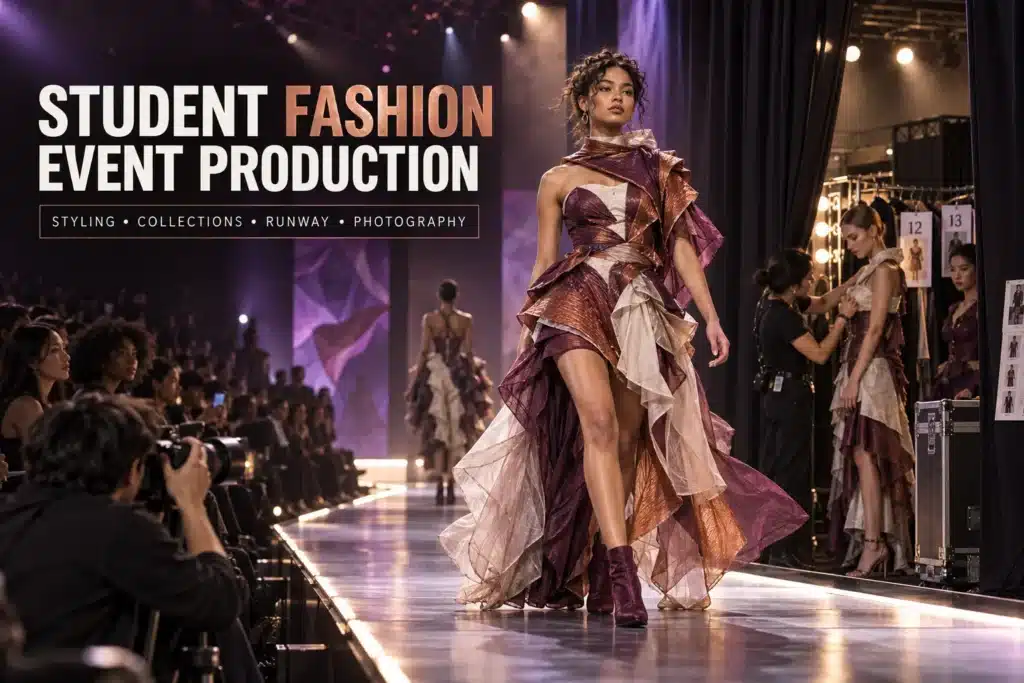
Table Of Content
- What Is a Student Fashion Event?
- Why Fashion Events Matter for Students
- Fashion Event Planning for Students
- How Does Student Fashion Event Production Work?
- Building a Collection for the Event
- Garment Preparation Before Styling
- Runway Photography Versus Editorial Photography
- Post-Event Photography and Selection
- Common Student Fashion Event Problems
- Fashion Event Planning Checklist
- Watch a Student Fashion Event in Action
