

Students planning a fashion career after Class 12 often compare two undergraduate options: B.Sc. Fashion Design and B.Des Fashion Design.
The BSc Fashion Design vs BDes decision depends on how you want to learn. A B.Sc. Fashion Design & Technology programme may combine creative design with textiles, garment construction, CAD, manufacturing and merchandising. A B.Des programme generally gives greater attention to design thinking, experimentation, studio work and creative problem-solving.
Curricula vary, so compare the syllabus, training, internships and portfolio opportunities.
BSc Fashion Design vs BDes: Quick Comparison
Factor | BSc Fashion Design | BDes Fashion Design |
Full form | Bachelor of Science in Fashion Design | Bachelor of Design in Fashion Design |
Course type | Undergraduate degree | Undergraduate design degree |
Typical focus | Creative and technical fashion learning | Design process and creative development |
Duration | Varies; ISFT programme is 3 years | Varies; NIFT B.Des is 4 years |
Construction and textiles | Commonly included | Commonly included |
CAD and digital design | May be included | Depends on curriculum |
Portfolio and projects | Usually included | Usually a major component |
Best suited for | Creative, technical and business exposure | Design-centred education |
What Is BSc Fashion Design?
B.Sc. Fashion Design is a bachelor’s degree that combines creative, technical and practical fashion subjects.
At ISFT, the B.Sc. Fashion Design & Technology programme lasts three years across six semesters. Students who have passed Standard XII in any discipline can apply.
Its curriculum includes:
- Design principles and textile science
- Sewing, pattern making and garment construction
- Fashion illustration and draping
- CAD and advanced CAD
- Fashion merchandising and forecasting
- Garment manufacturing and quality control
- Visual merchandising and public relations
- Portfolio development and entrepreneurship
Practical training and internships are included, covering garment design, construction, production and presentation.
What Is BDes Fashion Design?
B.Des stands for Bachelor of Design. It is an undergraduate degree commonly focused on design thinking, research, concept development, experimentation and studio-based learning.
A B.Des Fashion Design curriculum may include design fundamentals, illustration, textiles, pattern development, garment construction, craft studies, industry projects, portfolio development and a final design collection.
For example, NIFT offers a four-year B.Des programme. However, students should check the exact duration, subjects and admission process of each institution.
Difference Between BSc Fashion Design and BDes
1. Learning Approach
A B.Sc. may combine design, technology, garment development and fashion business. ISFT’s programme includes construction, CAD, merchandising, manufacturing and quality control alongside creative subjects.
A B.Des is generally organised around research, concepts, experimentation, design development and final outcomes. Design methodology and studio projects may receive stronger emphasis.
This does not mean a B.Sc. lacks creativity or a B.Des lacks technical learning. The balance simply varies.
2. Duration and Eligibility
ISFT’s B.Sc. Fashion Design & Technology programme lasts three years. NIFT’s B.Des programmes last four years.
Both routes can be available after Class 12. ISFT accepts students from Arts, Commerce and Science. Admission requirements for B.Des programmes vary and may include entrance examinations, creative tests, interviews or portfolio reviews.
3. Syllabus
The BSc Fashion Design vs BDes syllabus comparison is more important than the degree title.
A B.Sc. curriculum may cover textiles, sewing, pattern making, construction, draping, CAD, merchandising, manufacturing, quality control and entrepreneurship.
A B.Des curriculum may cover design fundamentals, fashion research, illustration, textiles, craft studies, garment development, experimentation, industry projects and portfolio work.
Both can include considerable practical learning. Review the complete modules and ask how much time students spend on workshops, projects, software, internships and portfolio development.
4. CAD, Construction and Fashion Business
Students interested in technical fashion should check for sewing, pattern making, draping, manufacturing, fabric behaviour and quality control.
ISFT’s B.Sc. includes CAD, Advanced Computer Aided Design, Garment Manufacturing and Quality Control. It also covers merchandising, forecasting, visual merchandising, public relations and entrepreneurship.
B.Des programmes may offer similar subjects, but their depth varies. Ask which software is taught, how often it is used and whether digital work appears in the final portfolio.
5. Career Scope
Career options often overlap. Graduates from either degree may explore:
- Fashion design and styling
- Fashion illustration
- Textile design
- Fashion merchandising
- Trend forecasting
- Fashion consulting and communication
- Garment development
- Entrepreneurship
Your portfolio, practical skills, internships, software knowledge, communication and industry exposure usually matter more than whether the degree title is B.Sc. or B.Des.
Which Degree Is Better for Fashion Designing?
Consider BSc Fashion Design if you:
- Want creative and technical fashion learning
- Enjoy textiles, construction and garment development
- Want to learn CAD and fashion technology
- Are interested in manufacturing or quality control
- Want exposure to merchandising and entrepreneurship
Consider BDes Fashion Design if you:
- Prefer a design-centred education
- Enjoy concept development and experimentation
- Want extensive studio and project-based learning
- Are interested in design research and creative problem-solving
Neither degree automatically has more value. The institution, curriculum, training, exposure and your portfolio all affect the outcome.
Questions to Ask Before Choosing
- What subjects will I study?
- How much practical work is included?
- Which digital tools will I learn?
- Will I build a professional portfolio?
- Are internships and industry projects included?
- Does the course cover fashion business?
- Does the duration fit my education plan?
- Does the curriculum support my preferred career?
Final Thoughts
The difference between BSc Fashion Design and BDes is mainly the learning approach. A B.Sc. can provide a mix of creative, technical and commercial fashion education, while a B.Des can offer a strongly design-focused route based on research, projects and experimentation.
Compare the actual programme rather than choosing by degree name. The best course is the one that supports how you want to learn and the fashion career you want to build.
FAQs
1. Which is better, BDes or BSc Fashion Designing?
Neither is universally better. B.Sc. may suit creative and technical learners, while B.Des may suit students who prefer design-centred education.
2. Are BSc Fashion Design and BDes undergraduate degrees?
Yes. Both are bachelor’s-level degree programmes.
3. How long are the courses?
Duration varies. ISFT’s B.Sc. programme lasts three years, while NIFT’s B.Des programme lasts four years.
4. Can Commerce students study BSc Fashion Design?
Yes. ISFT accepts students who have passed Standard XII in any discipline.
5. Which course is better for CAD?
It depends on the institution. ISFT’s B.Sc. curriculum includes CAD and Advanced CAD. Check each B.Des syllabus for equivalent training.
6. Which degree is best for starting a fashion brand?
Either can provide a foundation. Choose a course covering design, production, merchandising, portfolio development and business skills.
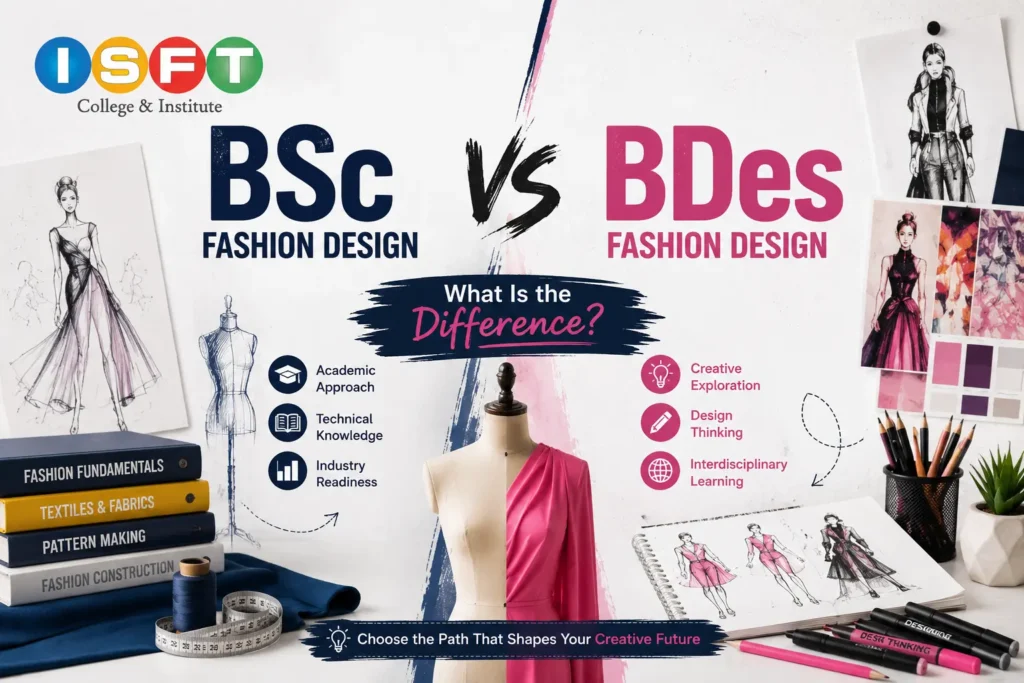
Table Of Content
