

Fashion editorial planning is the process of bringing clothes, styling, location, models, poses, lighting and photography together to communicate a visual story. Unlike basic garment documentation, an editorial shoot does not only show what the model is wearing. It creates a mood, introduces a character or explores an idea through a connected series of images.
For fashion students, this process can be exciting and slightly confusing. It is easy to collect dramatic pose references, beautiful locations and bold makeup images. The harder task is making sure those choices belong to the same story.
An editorial becomes stronger when every element has a reason. The outfit supports the character. The location creates context. The pose expresses emotion. The composition guides attention, while lighting shapes the mood.
Without that connection, a shoot may contain attractive individual photographs but no clear direction. It looks less like a fashion story and more like several good ideas trying to share one frame without introducing themselves.
What Is a Fashion Editorial?
A fashion editorial is a planned series of photographs that uses clothing and styling to communicate an idea, mood or story.
It may be created for:
- A student portfolio
- A fashion magazine-style project
- A styling assignment
- A designer collection
- A visual campaign
- A college project
- A digital publication
- Social media storytelling
- A creative team portfolio
An editorial may follow a visible storyline, such as a character moving through different locations. It may also communicate a less literal mood through colour, pose, texture and composition.
The photographs should feel connected even when the model changes position, garment or background.
This connection may come from:
- One central concept
- A repeated colour palette
- Consistent styling
- Related locations
- Similar lighting
- A planned emotional progression
- Repeated shapes or props
- A controlled editing style
A good editorial makes the viewer curious about the next image.
Fashion Editorial Versus a Regular Fashion Photoshoot
Not every fashion photoshoot is an editorial. Different shoot formats serve different purposes.
Point | Fashion editorial | Basic fashion shoot |
Main purpose | Communicate a story, mood or idea | Photograph garments or looks |
Image sequence | Designed to work as a connected series | Images may work independently |
Styling | Often concept-led | May focus mainly on presenting clothing |
Location | Supports the story | May provide a clean or practical background |
Poses | Express character and emotion | Often selected to show garments clearly |
Composition | May be experimental | Usually direct and product-focused |
Garment visibility | Can vary across images | Generally remains a main priority |
Final selection | Edited into a visual sequence | Selected as individual strong images |
An editorial can still show garments clearly, and a regular shoot can still be creative. The main difference is how strongly the images depend on a shared narrative.
Begin with the Clothes
The garments should be studied before developing the editorial story.
Students should look at:
- Silhouette
- Colour
- Fabric
- Texture
- Surface detail
- Historical or cultural references
- Construction
- Movement
- Transparency
- Weight
- Intended wearer
- Overall mood
Identify the visual clues
A sharply tailored black outfit may suggest control, structure or authority. A soft layered dress may suggest movement, memory or freedom. These are not fixed meanings, but they can guide concept development.
Find the strongest details
List what should remain visible in the photographs:
- Sleeve volume
- Neckline
- Embroidery
- Draping
- Layering
- Back construction
- Print placement
- Accessory
- Hem movement
The story should not hide every feature that makes the garment interesting.
Examine the full group
When several garments are included, identify what connects them. A fashion editorial can contain variation, but the complete selection should still support the concept.
Styling cannot create a convincing connection between completely unrelated garments without considerable effort. It can help, certainly, but it does not carry emergency glue for every collection problem.
Develop the Editorial Story
How Does Fashion Editorial Planning Create a Story?
Fashion editorial planning creates a story by deciding who the character is, where the scene takes place, what mood is being communicated and how the images progress. Clothes, location, pose and composition are then selected to support that direction.
A simple editorial idea can be built from five questions:
- Who is the character?
- Where are they?
- What are they feeling or doing?
- How do the clothes support the idea?
- What changes from the first image to the last?
Define the character
The character does not need a complete biography, but the team should understand their attitude.
Possible directions include:
- Confident
- Rebellious
- Calm
- Mysterious
- Playful
- Isolated
- Powerful
- Romantic
- Curious
- Restless
Define the setting
The location provides context. A clean studio, crowded street, old building, modern structure, natural landscape or domestic interior can suggest different stories.
Define the action
What is happening in the photographs? The model may be waiting, moving, exploring, celebrating, observing or changing emotionally.
Define the progression
A series becomes more interesting when it develops. The opening image may introduce the setting, the middle images may reveal the character and the closing image may create resolution or leave a question.
The story can remain simple. A complicated plot is not required to photograph an outfit. The team is making a fashion editorial, not trying to complete a three-hour film before lunch.
Write a Clear Concept Statement
A concept statement summarises the editorial direction in one or two sentences.
For example:
A quiet editorial exploring isolation in a busy city, using structured monochrome clothing, distant expressions and wide architectural compositions.
This statement identifies:
- Mood: quiet and isolated
- Setting: city
- Clothing: structured and monochrome
- Expression: distant
- Composition: wide and architectural
A weaker concept might say:
A stylish and creative urban fashion shoot.
This description is too broad. Almost any city-based fashion image could fit it.
A useful concept statement allows the photographer, stylist, model and makeup artist to imagine a similar result.
Building an Editorial Styling Concept
An editorial styling concept explains how garments, accessories, hair, makeup and body presentation will communicate the story.
Garment selection
Choose looks that fit the concept and provide enough visual variation across the sequence.
Layering
Layering can change the silhouette and create progression. A coat may appear closed in one image and open in another, revealing a different garment beneath.
Accessories
Accessories may help define character or time period. Select them carefully so they do not compete with the clothes.
Footwear
Footwear influences posture, movement and the practical use of a location. It should be tested with the complete outfit.
Hair
Hair can communicate control, softness, movement, period or mood. It should also keep important garment areas visible.
Makeup
Makeup supports the character and lighting. It may be natural, graphic, expressive, period-inspired or unconventional, depending on the concept.
Props
A prop should contribute to the story. It may create action, reveal character or connect the images.
Adding a chair simply because one is available does not automatically create narrative depth. Sometimes it only creates a photograph of a model sitting on a chair.
Creating a Focused Mood Board
A mood board translates the written idea into visual references.
It may include:
- Garments
- Colour palette
- Location
- Lighting
- Model appearance
- Hair
- Makeup
- Poses
- Props
- Framing
- Texture
- Editing direction
Select references for a reason
Every image should explain a specific part of the plan. Add short labels such as:
- “Lighting reference”
- “Pose direction”
- “Colour mood”
- “Location texture”
- “Hair shape”
- “Wide composition”
Avoid mixed visual directions
One reference may show soft natural light, while another uses strong coloured studio lighting. Both can be attractive, but they may not belong to the same editorial.
Include the actual clothes
Garment sketches, fitting photographs and fabric samples should appear beside the references. This keeps the concept grounded in the available clothing.
Limit the number of references
A focused board communicates more clearly than several pages of unrelated inspiration. Editing the mood board is part of the creative process.
Choosing a Location That Supports the Story
The location should provide context without overpowering the clothes.
Architectural location
Clean lines, concrete, glass, stairs or geometric structures may support tailored or modern clothing.
Natural location
Fields, gardens, beaches or wooded areas may support soft, organic or movement-based stories.
Urban street
Street settings can create energy, realism and cultural context. Public movement and visual clutter need to be managed.
Domestic interior
A bedroom, kitchen, corridor or living space can create intimacy and character. Every object visible in the frame becomes part of the story.
Studio
A studio provides control and can support minimal, surreal or highly styled editorials through backgrounds, lighting and props.
Questions to ask before confirming a location
- Does it match the concept?
- Do the garment colours stand out?
- Is photography permitted?
- Is there enough light?
- Where will the model change?
- Is the surface safe for the footwear?
- Can the team store garments?
- Will the public interrupt the shoot?
- Is there shelter if the weather changes?
- Does the location work for both wide and close frames?
A beautiful location that provides no changing space, no permission and forty curious onlookers may become less beautiful after the first ten minutes.
Fashion Shoot Storytelling Through Poses
Fashion shoot storytelling depends heavily on body language. A pose can communicate confidence, tension, movement, softness or distance without using words.
Begin with the character
The model should understand who they are within the editorial. “Look serious” is less useful than explaining why the character feels controlled or distant.
Match the pose with the garment
A pose should reveal important clothing details.
For example:
- A shoulder turn may show a sculptural sleeve.
- A walking pose may reveal fabric movement.
- A seated pose may show how a structured garment folds.
- An arm position may uncover a waist detail.
- A back-facing pose may highlight rear construction.
Plan pose families
Instead of copying exact poses, prepare groups such as:
- Strong standing
- Seated and reflective
- Walking
- Turning
- Close portrait
- Interaction with setting
- Detail-focused hand placement
This gives the model and photographer room to respond naturally.
Check the hands
Hands can support or weaken an image. They should look intentional and relaxed unless tension is part of the story.
Direct in small steps
Give one instruction at a time. Adjust the shoulders, hands, face and gaze gradually.
When ten directions arrive at once, the model may remember only the final one—and nobody is certain whether that was “lift your chin” or “show the sleeve.”
Clothing Campaign Composition
Clothing campaign composition is the arrangement of the model, clothes, background, props and empty space within the frame. Composition directs attention and affects the meaning of the photograph.
Centre composition
Placing the model in the middle creates stability, formality or directness.
Rule-of-thirds composition
Positioning the subject away from the centre can create movement and leave space for the setting or campaign text.
Symmetrical composition
Balanced sides may support structured, controlled or architectural stories.
Asymmetrical composition
Unequal visual elements can create energy while remaining balanced.
Wide composition
A wide frame gives the location a stronger role. It may show isolation, scale or environmental context.
Tight crop
Close framing highlights expression, makeup, jewellery or garment details.
Low camera angle
A lower viewpoint may make the model appear powerful or make the garment feel more dramatic.
High camera angle
A higher viewpoint can create vulnerability, graphic shapes or an unusual relationship with the background.
Negative space
Empty space can create calm, tension or room for text. It should feel intentional.
Students should plan a range of compositions. An editorial containing only central full-length photographs may document the looks but struggle to create visual rhythm.
Connecting Colour Across the Editorial
Colour helps hold separate images together.
The plan may use:
- Monochromatic colour
- Complementary contrast
- Warm palette
- Cool palette
- Muted tones
- High saturation
- Neutral clothing with a coloured background
- Repeated accent colour
Students should consider how garment colours interact with the location. A green outfit may blend into a garden when it needs to stand out, or that connection may be used intentionally.
Hair, makeup and props also influence colour balance. A small bright accessory can become the first element viewers notice.
The team should test colours under the intended lighting because fabric and makeup may appear different on camera.
Planning Lighting and Mood
Lighting shapes the emotional quality of the editorial.
Soft light
Soft light creates gradual shadows and can support calm, romantic or natural concepts.
Hard light
Hard light creates stronger contrast and defined shadows. It may support bold, graphic or dramatic stories.
Side light
Side lighting can reveal garment texture and body form.
Backlight
Backlighting may highlight edges, movement or transparent fabric. Front details may need additional lighting.
Low-key lighting
Darker images with controlled highlights can create mystery or tension.
Bright lighting
Even or strong illumination can produce a clean, direct or energetic mood.
Natural light
Natural light changes through the day. The schedule should consider its direction and strength.
The lighting choice should suit both the story and the clothing. Dramatic shadows are less helpful when they hide the exact surface detail the designer worked on for three weeks.
Creating an Editorial Shot List
A shot list makes sure the shoot produces a complete sequence.
A useful list may include:
Shot | Purpose | Composition | Garment focus |
Opening frame | Introduce the setting | Wide | Full silhouette |
Character portrait | Establish mood | Close-up | Neckline and makeup |
Movement frame | Add energy | Full-length | Fabric movement |
Location interaction | Build story | Asymmetrical | Complete look |
Detail frame | Show craftsmanship | Tight crop | Surface detail |
Transition frame | Connect the sequence | Mid-length | Styling and expression |
Closing frame | End the story | Wide or direct portrait | Hero look |
Students should also note the required orientation:
- Vertical
- Horizontal
- Square
- Wide banner
- Close detail
The intended portfolio, website or social-media use may require different formats.
Sequencing the Editorial Story
The final images should be arranged deliberately.
Opening image
The first image introduces the character, place or mood. It should create enough interest to encourage the viewer to continue.
Development images
The middle sequence reveals more about the garments and story. It may move between wide shots, portraits and details.
Turning point
A change in pose, outfit, light or location may shift the emotional direction.
Closing image
The final image should feel considered. It may resolve the story or leave the viewer with an open question.
Visual rhythm
Avoid placing several nearly identical frames beside one another. Change scale, angle and energy while maintaining the overall concept.
An editorial sequence is similar to a sentence. If every image performs the same role, it starts to sound like the same word repeated seven times.
Preparing the Clothes Before the Shoot
Every garment should be inspected and organised.
Check:
- Fit
- Fastenings
- Seams
- Hems
- Pressing
- Loose threads
- Surface decoration
- Transparency
- Undergarment requirements
- Accessories
- Footwear
- Movement
- Look number
Complete a fitting before the shoot where possible. Test the garments with the planned styling and poses.
A structured garment may not allow the pose shown on the mood board. A long hem may require different footwear or movement. Discovering these issues during a fitting protects valuable shoot time.
Team Roles in an Editorial Photoshoot
A student editorial may involve:
Creative director
Maintains the overall story and visual direction.
Stylist
Selects garments, accessories and complete looks.
Photographer
Translates the concept into lighting, framing and images.
Model
Communicates character through pose, movement and expression.
Hair stylist
Develops hair according to the visual direction.
Makeup artist
Creates the planned makeup while considering lighting and camera.
Garment assistant
Manages clothing, changes and small adjustments.
Shoot coordinator
Tracks the schedule, shot list and communication.
One student may perform several roles in a smaller project. The responsibilities should still be defined so that essential tasks are not forgotten.
Building a Practical Shoot Schedule
The schedule should include:
- Team arrival
- Location preparation
- Lighting test
- Hair and makeup
- First fitting
- Look changes
- Individual shot groups
- Detail photographs
- Breaks
- Backup time
- Pack-up
Shoot timings should account for garment complexity and location movement.
If natural light is important, prioritise the key frames during the suitable period. Prepare alternative indoor or sheltered options where relevant.
A schedule should provide direction without becoming so rigid that one late eyeliner adjustment sends the entire production into emotional collapse.
Common Fashion Editorial Planning Mistakes
Starting with a location instead of the clothes
The location may be beautiful but unrelated to the garments. Build the concept from the fashion.
Using a vague story
Words such as stylish, creative and modern do not give the team enough direction. Define the character, mood and setting.
Mixing several concepts
A romantic makeup reference, aggressive pose direction and playful location may not work together without a clear reason.
Overstyling the garments
Too many accessories can hide silhouette and construction. Remove elements that do not support the story.
Copying poses without considering clothing
The pose should reveal the garment. Adapt references to fit the actual design.
Shooting only one type of frame
A complete editorial needs variation between wide, full-length, portrait and detail images.
Forgetting continuity
Hair, accessories, garment fastenings and props may change accidentally between related frames. Review the images during the shoot.
Ignoring practical requirements
Permissions, weather, changing facilities, safety and garment transport can affect the final result.
Depending on editing to create the concept
Post-production can refine colour and consistency, but it cannot replace a missing story, unsuitable styling or incomplete shot list.
Watch Fashion Editorial Planning in Practice
Youtube Video : https://www.youtube.com/watch?v=d29zBNInpNk
View this fashion editorial photoshoot video to observe how clothing, styling, model direction, setting and photography come together within one visual idea.
While watching, notice:
- How the clothes relate to the environment
- How poses communicate mood
- How framing changes the role of the location
- Whether styling supports or competes with the garments
- How wide shots and close-ups create rhythm
- How the sequence begins and develops
- Which frames show the clothing most clearly
The final photographs are important, but the relationships between the elements reveal the planning behind them.
From Editorial Shoot to Student Portfolio
The portfolio should explain how the concept developed.
A complete project may include:
- Editorial title
- Concept statement
- Garment selection
- Mood board
- Colour palette
- Styling plan
- Hair and makeup direction
- Location reference
- Pose study
- Shot list
- Final image sequence
- Reflection
Students should select images that work together instead of adding every frame they like.
The reflection may answer:
- What communicated the story successfully?
- Which location area worked best?
- Did the styling support the clothes?
- Which poses showed the garment clearly?
- What changed during the shoot?
- What should be planned differently next time?
This demonstrates that the student understands both the outcome and the process.
Learning Editorial and Commercial Styling at ISFT
ISFT’s Diploma in Fashion Styling & Makeup includes Editorial & Magazine Styling, Styling for Commercial Campaigns and Fashion Photography in workshop mode. The Fashion & Styling curriculum also covers the role of a fashion stylist, body shapes, colour analysis, design principles, customisation, personal styling, celebrity styling, and styling for television, film and shows.
The programme additionally covers hair styling and fashion makeup, including editorial, theme-based and unconventional makeup topics. Professional practice, portfolio development and basic photography for content development are also included within the course structure.
The programme has a duration of four months and is open to groups including freshers, college students, homemakers, job changers, beauticians and bridal makeup artists.
Learners interested in connecting styling, makeup and photography can review the Fashion Styling and Makeup Diploma and contact ISFT for current admission information.
Conclusion
Fashion editorial planning gives clothes a visual context by connecting them with character, location, pose, composition and story. A successful editorial is not created by collecting several attractive references. It is created by deciding what the garments communicate and making every supporting element follow that direction.
Begin with a short concept statement. Then build a focused mood board, styling plan, location brief and shot list around the actual clothes. During the shoot, capture enough variation to create a sequence while maintaining continuity.
ISFT’s Diploma in Fashion Styling & Makeup includes editorial styling, commercial campaign styling and fashion photography alongside hair, makeup and portfolio development. Learners interested in understanding how complete fashion images are planned can review the course curriculum and discuss the programme with the ISFT admissions team.
FAQs
1. What is fashion editorial planning?
Fashion editorial planning is the process of developing a connected visual story using clothing, styling, location, models, poses, lighting and composition. The planning stage defines the concept, character and mood before the photographs are created. It also includes practical decisions such as fittings, permissions, schedules and shot lists. The goal is to produce a series of images that feels intentional rather than unrelated.
2. What should an editorial styling concept include?
An editorial styling concept should include garment selection, layering, accessories, footwear, hair, makeup and any relevant props. These elements should support the same character and story. The stylist should explain why each item belongs in the frame and check that important garment details remain visible. Complete looks should be tested on the model before the shoot where possible.
3. How is fashion shoot storytelling created without words?
Fashion shoot storytelling can be created through clothes, setting, body language, expression, lighting, colour and image sequence. A wide shot may introduce the environment, while a portrait reveals emotion. Movement can show urgency or freedom, and a still pose may suggest control or isolation. When these elements follow a shared concept, viewers can understand the mood without a written explanation.
4. Why is location important in a fashion editorial?
Location gives context to the clothes and character. Architecture may support structured fashion, while a natural environment may strengthen an organic or fluid concept. The location also affects colour, lighting, composition and practical arrangements. Students should select it after understanding the garments and story. A beautiful background is useful only when it contributes to the intended editorial direction.
5. What makes clothing campaign composition effective?
Effective clothing campaign composition directs attention towards the garment while using the background, model, props and negative space intentionally. Camera angle, framing and subject placement influence mood and visual balance. A campaign may use wide environmental images, direct central frames and close details within one sequence. The composition should match the image purpose and leave important design features visible.
6. How many photographs should a student fashion editorial include?
There is no fixed number that suits every project. The series should be long enough to introduce and develop the concept without repeating nearly identical frames. A student may include an opening image, full-length looks, portraits, movement shots, details and a closing frame. The final number should follow the project brief, portfolio layout and strength of the available photographs.
7. What is the difference between editorial styling and commercial styling?
Editorial styling often gives greater attention to story, mood and creative interpretation. Commercial styling usually needs to communicate clothing or a campaign message clearly for a defined audience. The two areas can overlap. Both require understanding garments, viewers, composition and project goals. Students should identify the purpose of the shoot before deciding how experimental or product-focused the styling should become.
8. Does ISFT’s Fashion Styling & Makeup Diploma include editorial styling?
Yes. ISFT’s Diploma in Fashion Styling & Makeup includes Editorial & Magazine Styling, Styling for Commercial Campaigns and Fashion Photography in workshop mode. The curriculum also covers personal styling, celebrity styling, colour analysis, hair styling, fashion makeup and portfolio development. Learners should review the current course page and contact ISFT for complete programme and admission details.
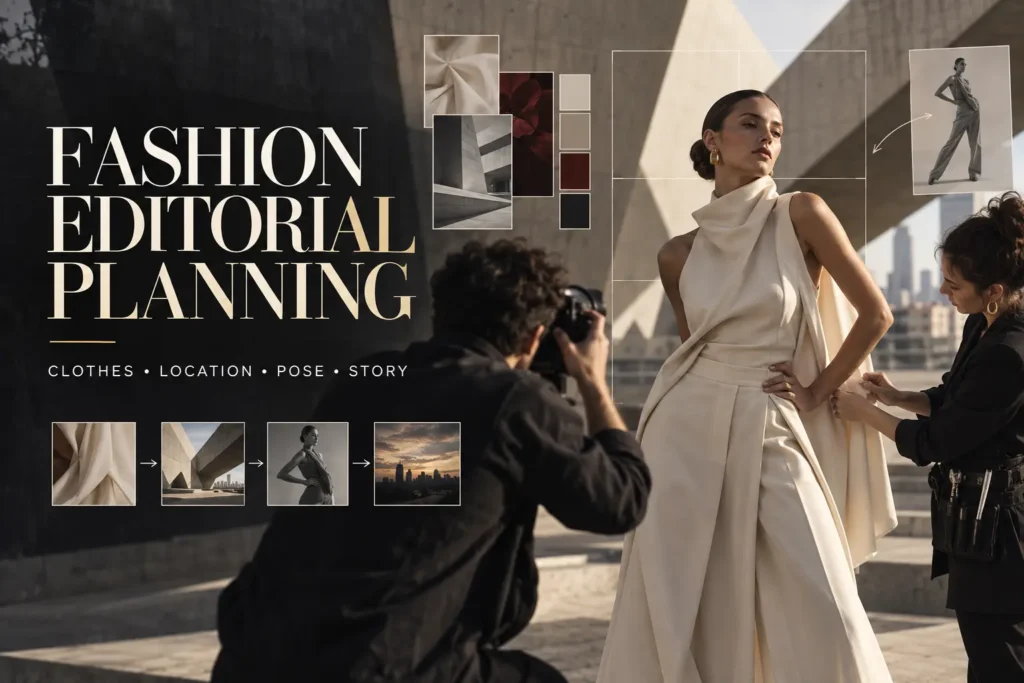
Table Of Content
- What Is a Fashion Editorial?
- Fashion Editorial Versus a Regular Fashion Photoshoot
- How Does Fashion Editorial Planning Create a Story?
- Building an Editorial Styling Concept
- Choosing a Location That Supports the Story
- Fashion Shoot Storytelling Through Poses
- Connecting Colour Across the Editorial
- Creating an Editorial Shot List
- Preparing the Clothes Before the Shoot
- Common Fashion Editorial Planning Mistakes
- Watch Fashion Editorial Planning in Practice
